
Core ‘Ngrato: Inside Dolce&Gabbana’s Love Letter to Italy at ICA Miami
Joelle Magazine | Culture · Design · Travel | Through June 14, 2026
——
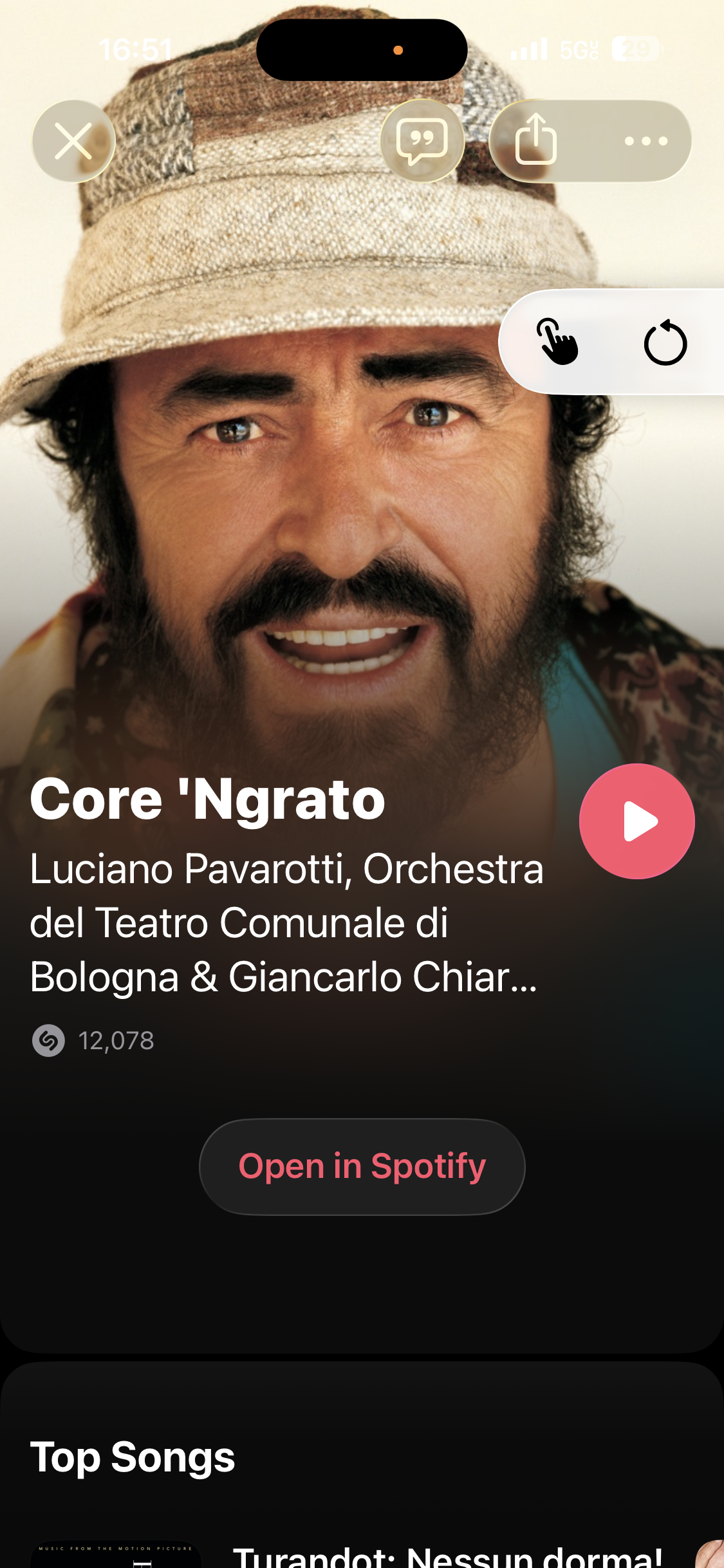
Somewhere inside From the Heart to the Hands, I raised my phone and Shazamed the room.
The result came back: Core ‘Ngrato. Luciano Pavarotti. A Neapolitan canzone written in 1911. The title translates as Ungrateful Heart.
I stood there for a moment and didn’t move. Not because it surprised me — but because it was so exactly right that it felt almost private, like catching a stranger reading your diary. An exhibition called From the Heart to the Hands was playing, in one of its most hushed spaces, a song about a heart that refuses to feel what it has been given. I thought about that for the rest of the afternoon. About what it means to be given beauty — real beauty, made by hand, over months — and walk past it without stopping. About how easy that is. How often I’ve done it.
That is what this exhibition does. It makes that refusal impossible.
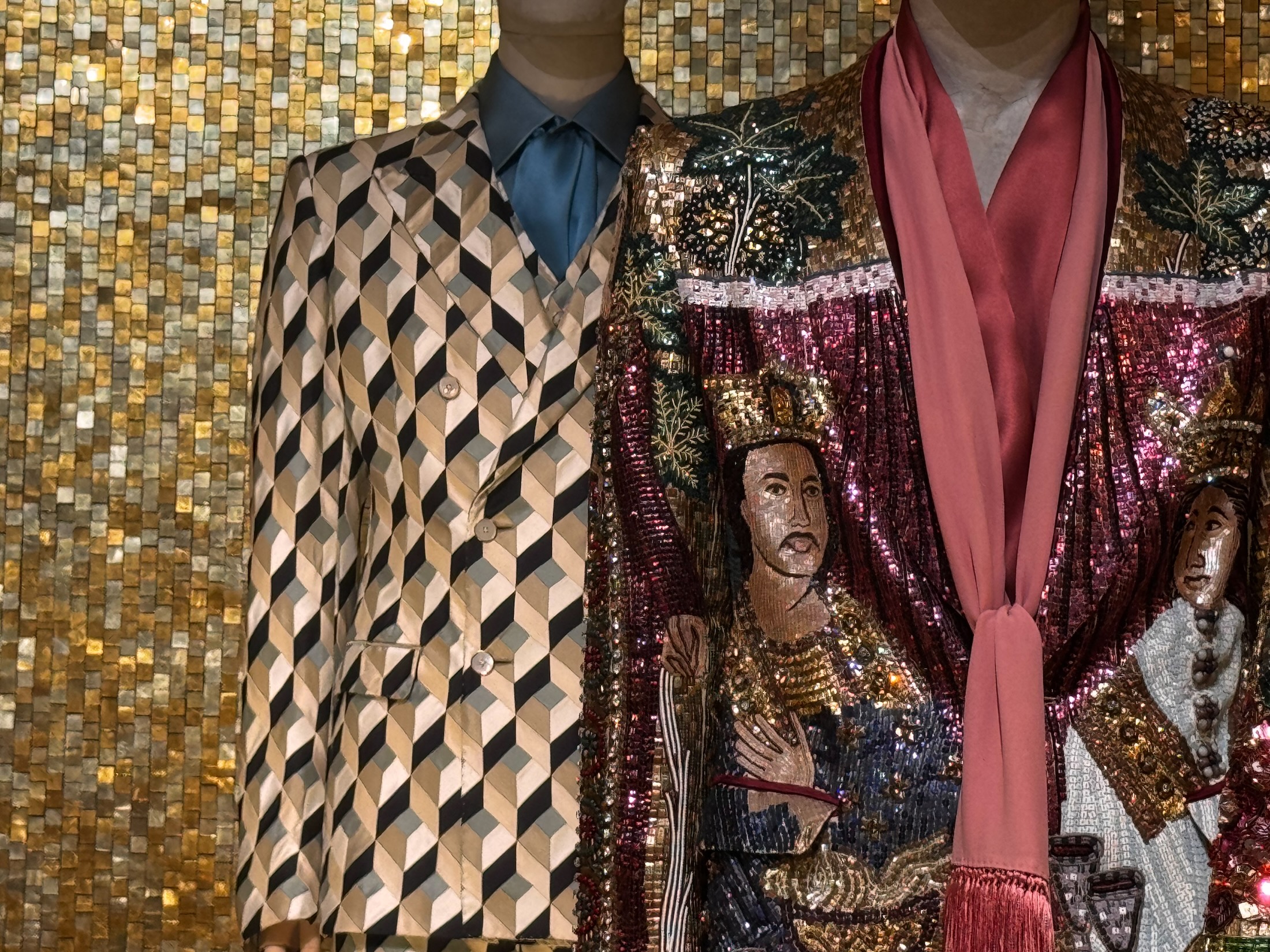
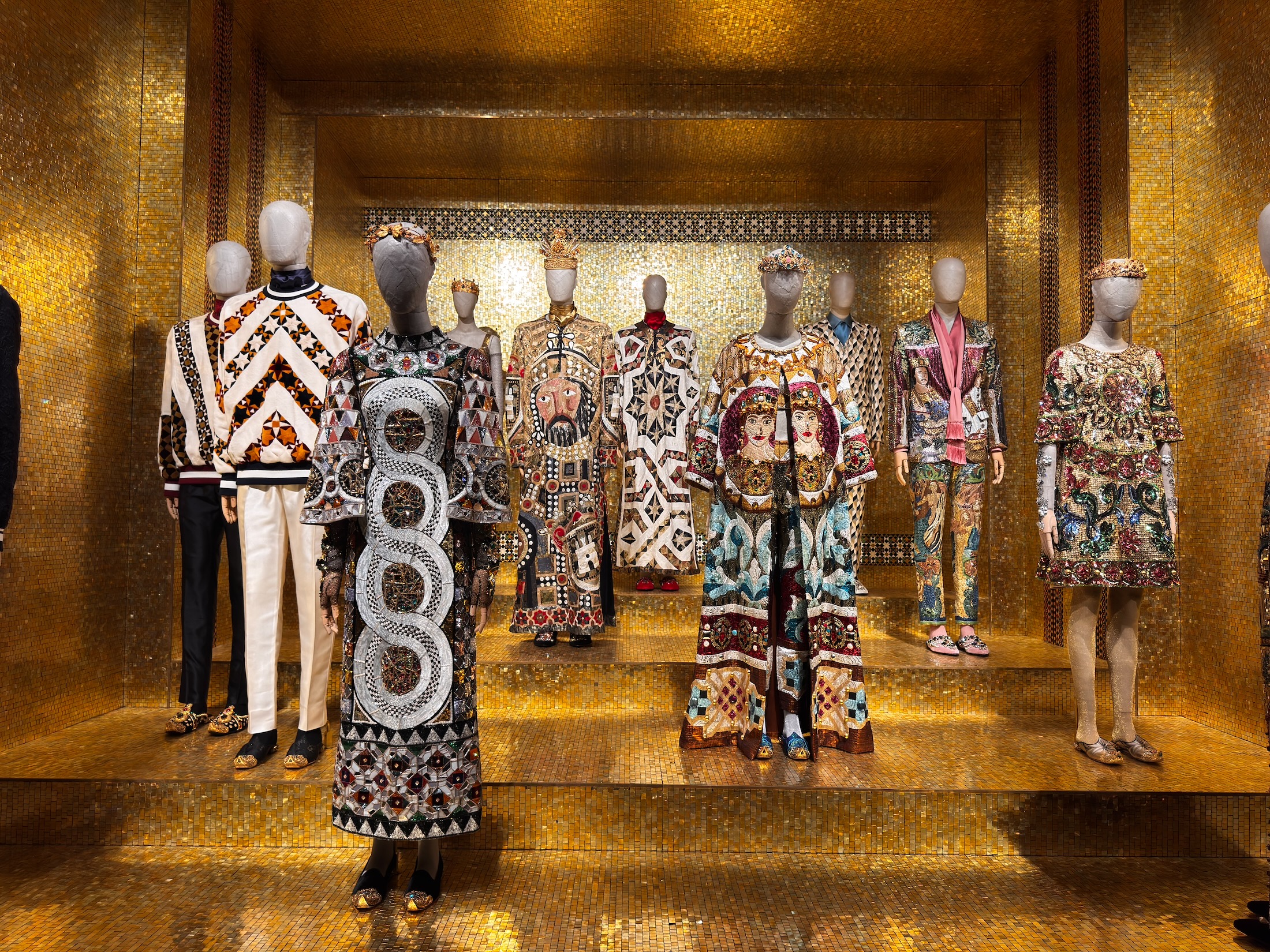
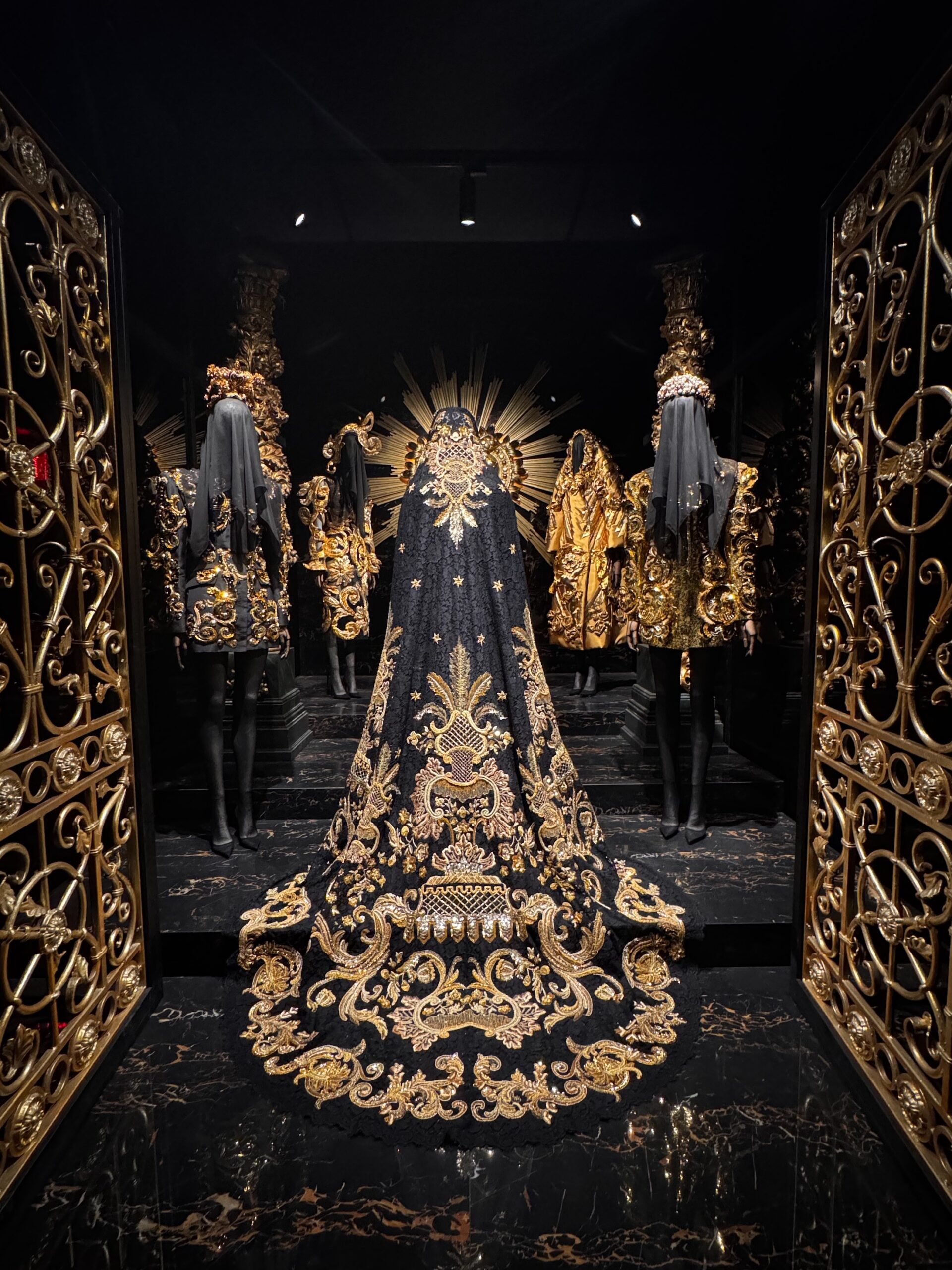
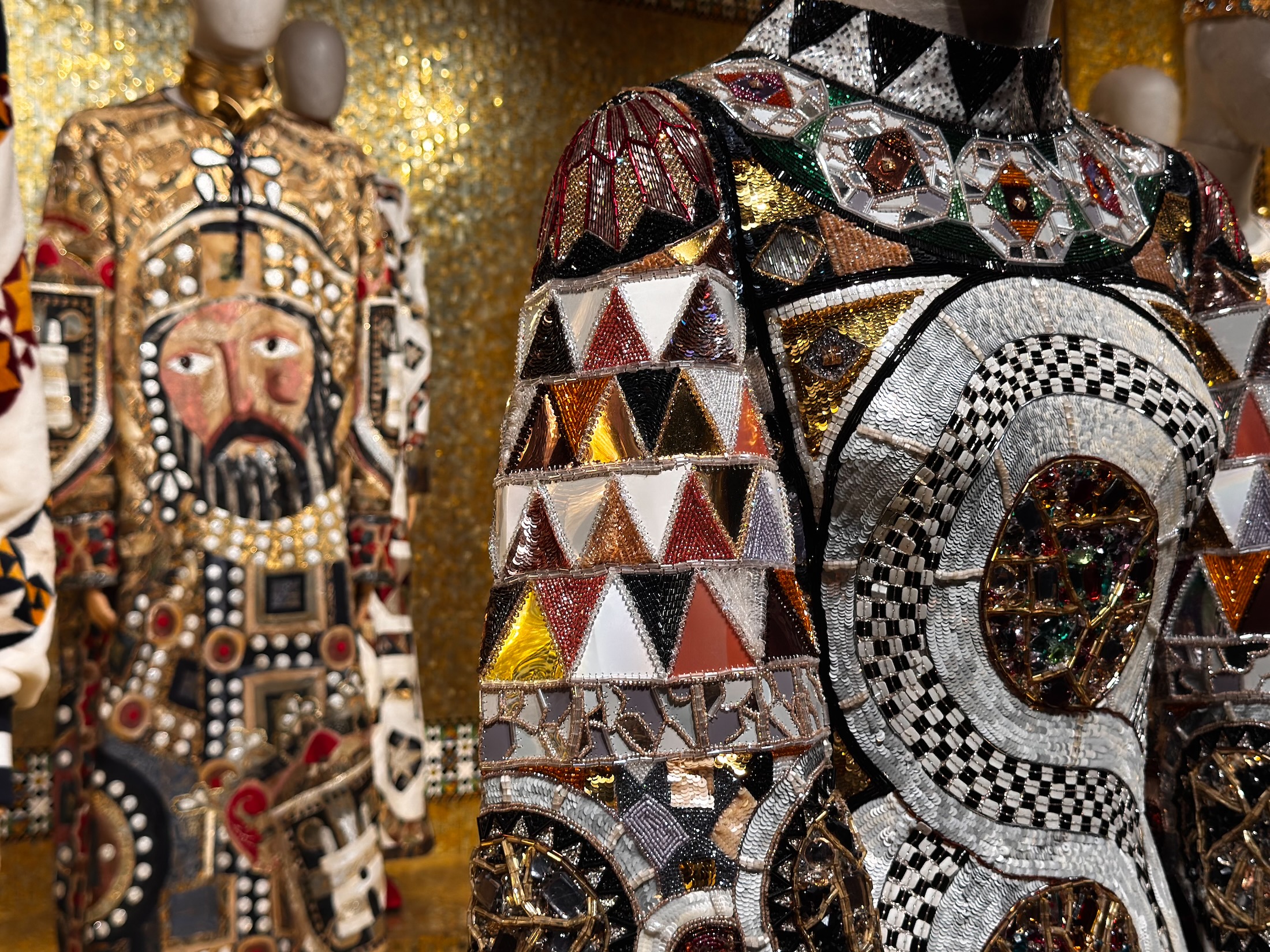
Byzantine gold. The Constantinian inheritance — mosaic, icon, sacred geometry — translated into Alta Sartoria with the patience the original craftsmen would have recognized.
——
From the Heart to the Hands: Dolce&Gabbana is at ICA Miami through June 14, 2026 — the U.S. debut after sold-out runs in Milan, Paris, and Rome, each extended because people kept coming back. Curator Florence Müller chose Miami over New York. She lives part of the year here and pushed hard for it. “There’s a communality between the exhibition and Miami,” she has said. “Both are Latin at their core.” Over 300 works across Alta Moda, Alta Sartoria, and Alta Gioielleria fill ICA’s newly acquired 30,000-square-foot space in the Design District — the former de la Cruz Collection. I gave it three hours. It needed more.
——
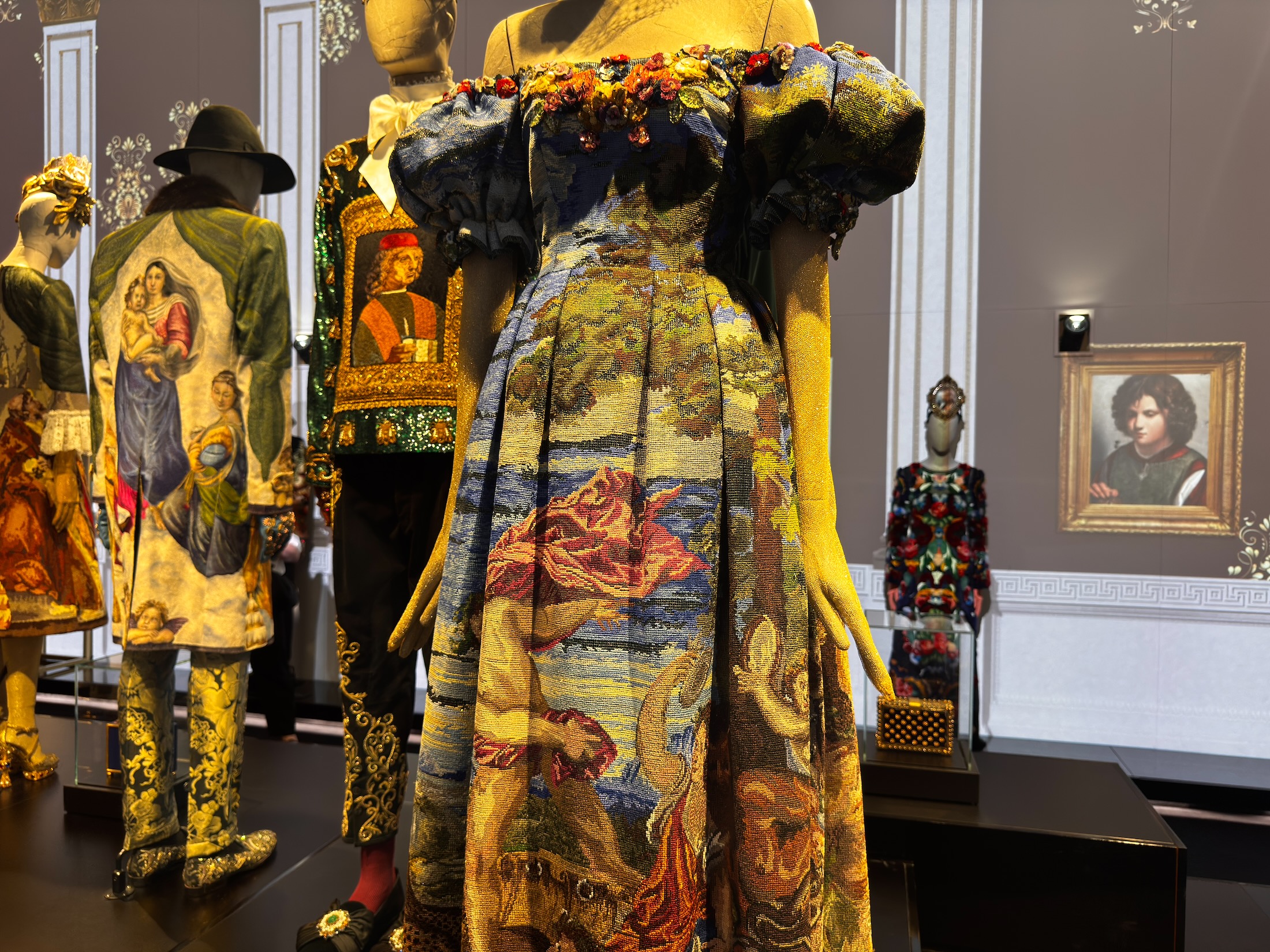
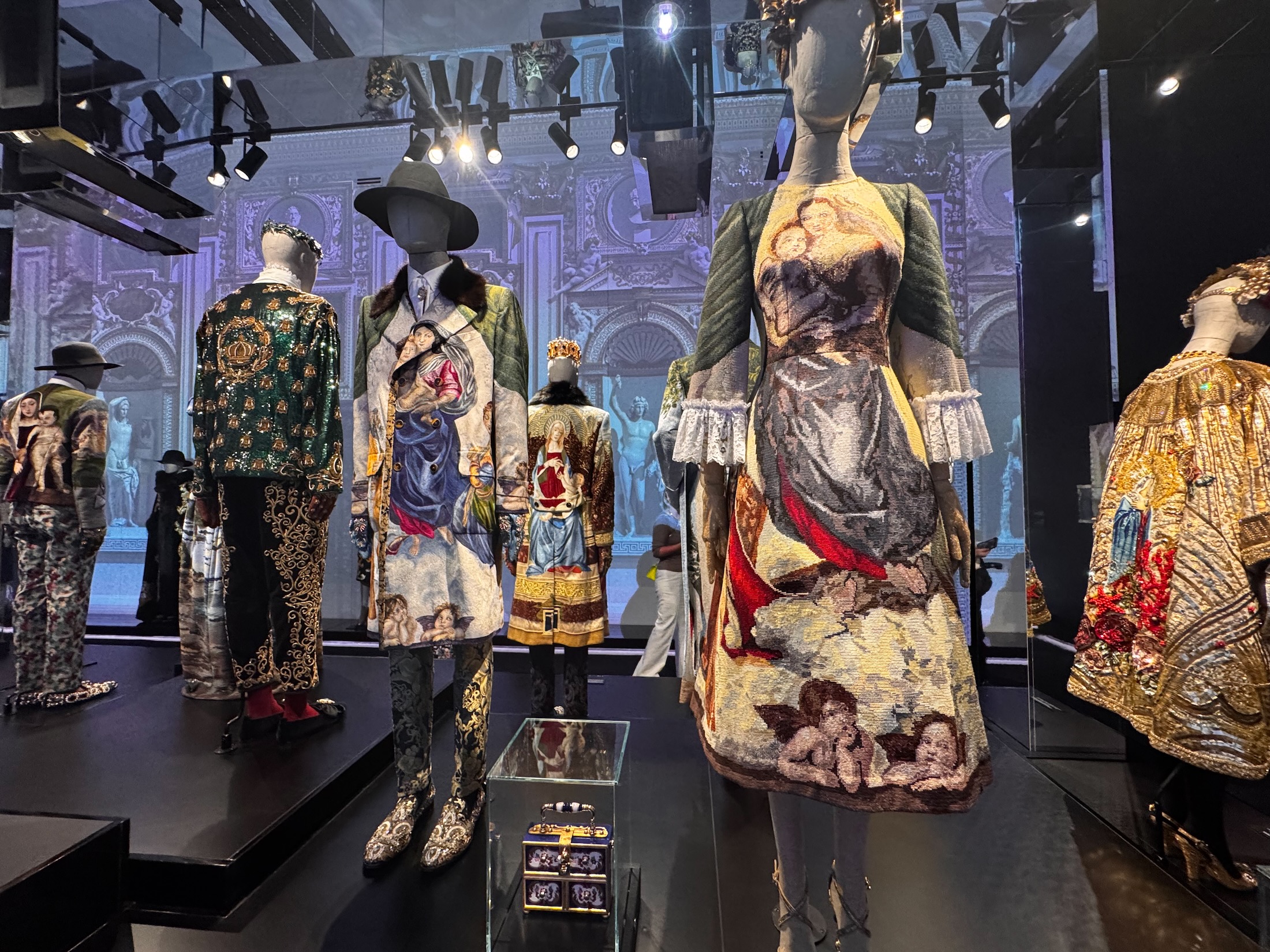
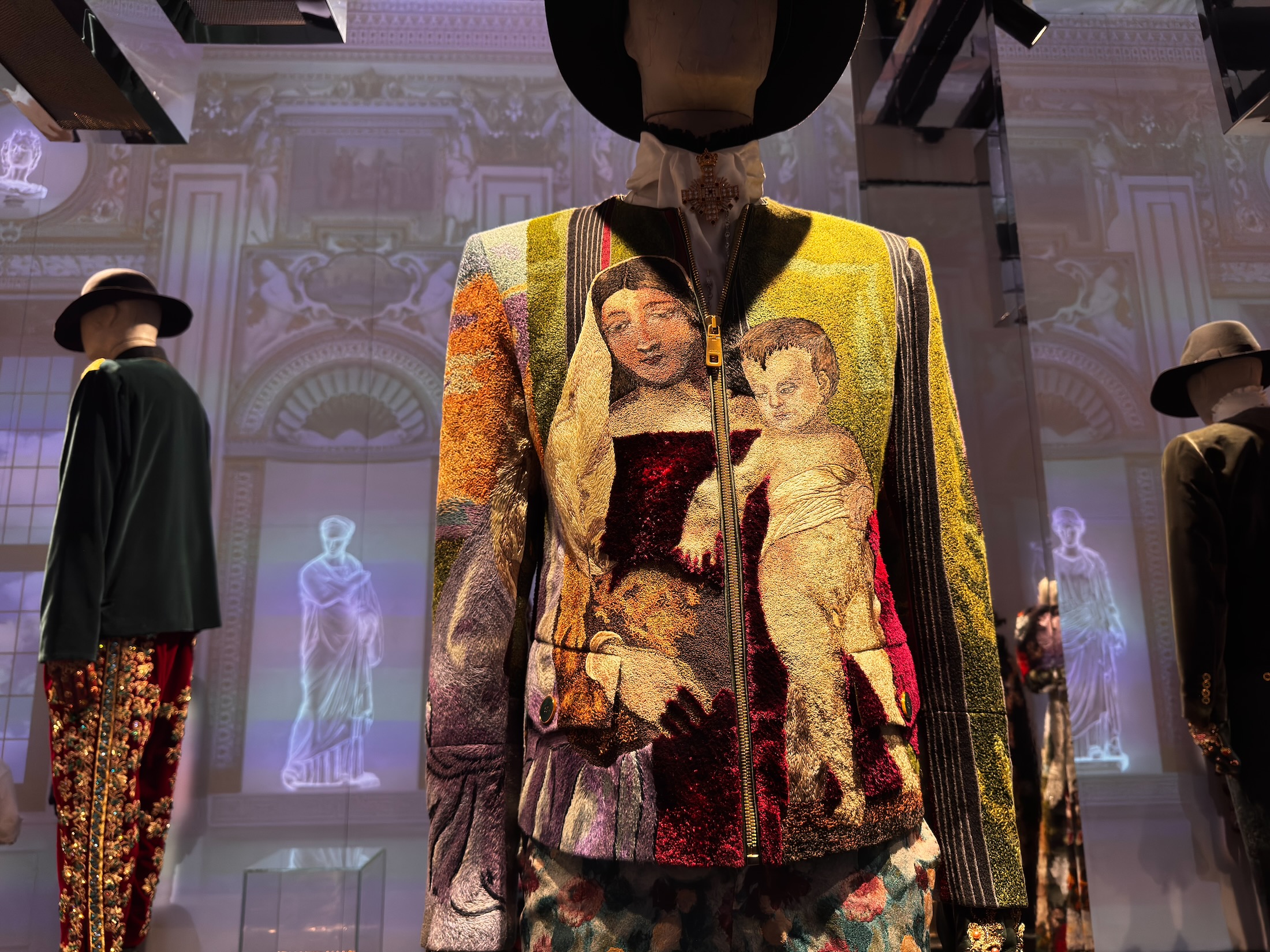
Raphael, Titian, the giants of Italian painting — worn. Alta Moda gowns tapestry-woven with Renaissance masterworks, each figure carrying centuries of Italian art history on a single skirt.
The first room stops you before you’re ready to be stopped. I walked in and immediately stepped to the side, out of the flow of other visitors, because I needed a moment to just look. A mirrored stage. Mannequins in crocheted gold and brocade jackets that read more like architecture than clothing. Twenty-foot walls hung salon-style with gilt-framed oil paintings by Anh Duong — a French-born artist of Spanish-Vietnamese descent who spent over a decade painting self-portraits in the most iconic Alta Moda pieces, evoking Taormina, Venice, Capri, Palermo. Italy not as backdrop. Italy as a way of seeing yourself. Naomi Campbell is on one wall in a feathered gown that belongs in a museum of portraiture, not a fashion archive. A woman beside me whispered something in Spanish to her friend and neither of them moved for a while either.
——
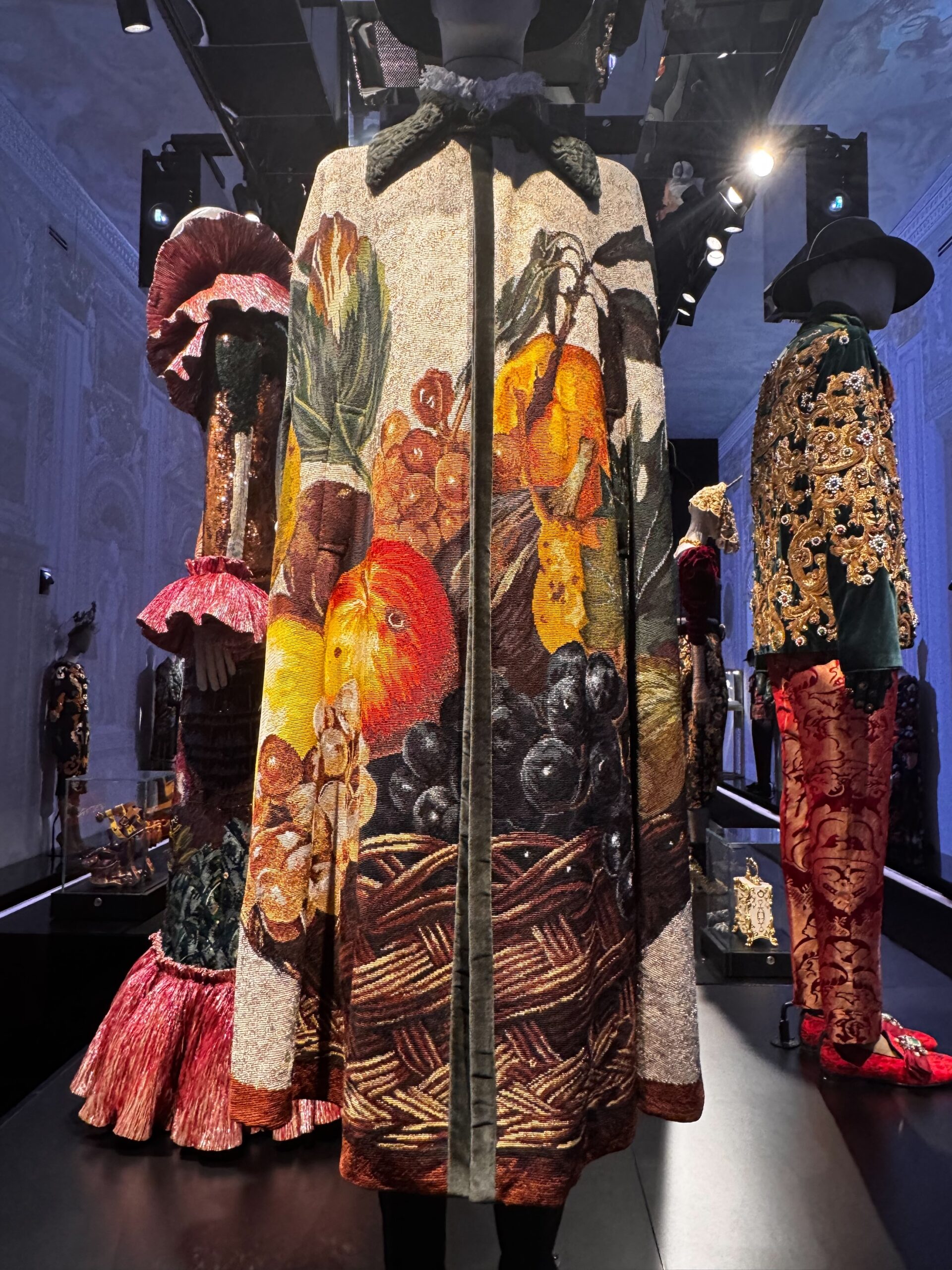
A Caravaggio still life in thread and bead — grapes, peaches, a wicker basket rendered at full painterly scale across a single cape. Not printed. Painted, slowly, by hand.
There is a section where the exhibition speaks directly to anyone who has ever thought seriously about the relationship between structure and beauty — between what holds a space together before anything decorative arrives. The wall text reads: “Constructing a garment is similar to building a house. Architects, like fashion designers, start with a sketch of the principal lines and volumes. The embellishments are added last — just as a house-building project passes into the hands of the decorators and painters.”
I’ve said versions of this to clients for twenty years. Seeing it on a wall inside an exhibition about couture felt strangely like being understood.
A cape nearby is embroidered entirely in a Caravaggio-scale still life — grapes, peaches, a wicker basket, rendered in thread and bead at full painterly resolution. The kind of thing that makes you lean in until your nose is almost touching the glass. You stop arguing about whether fashion is art. You just look.
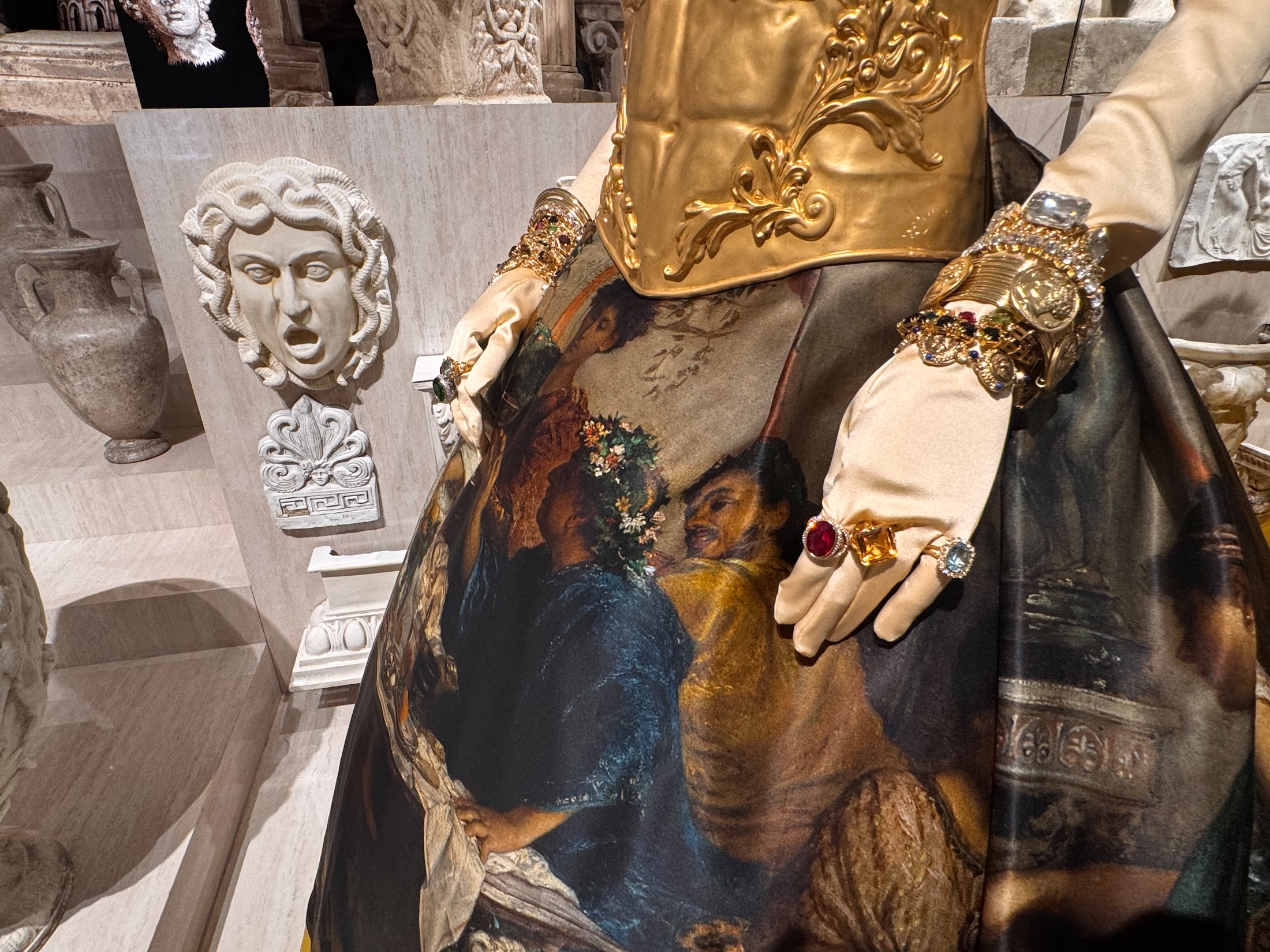
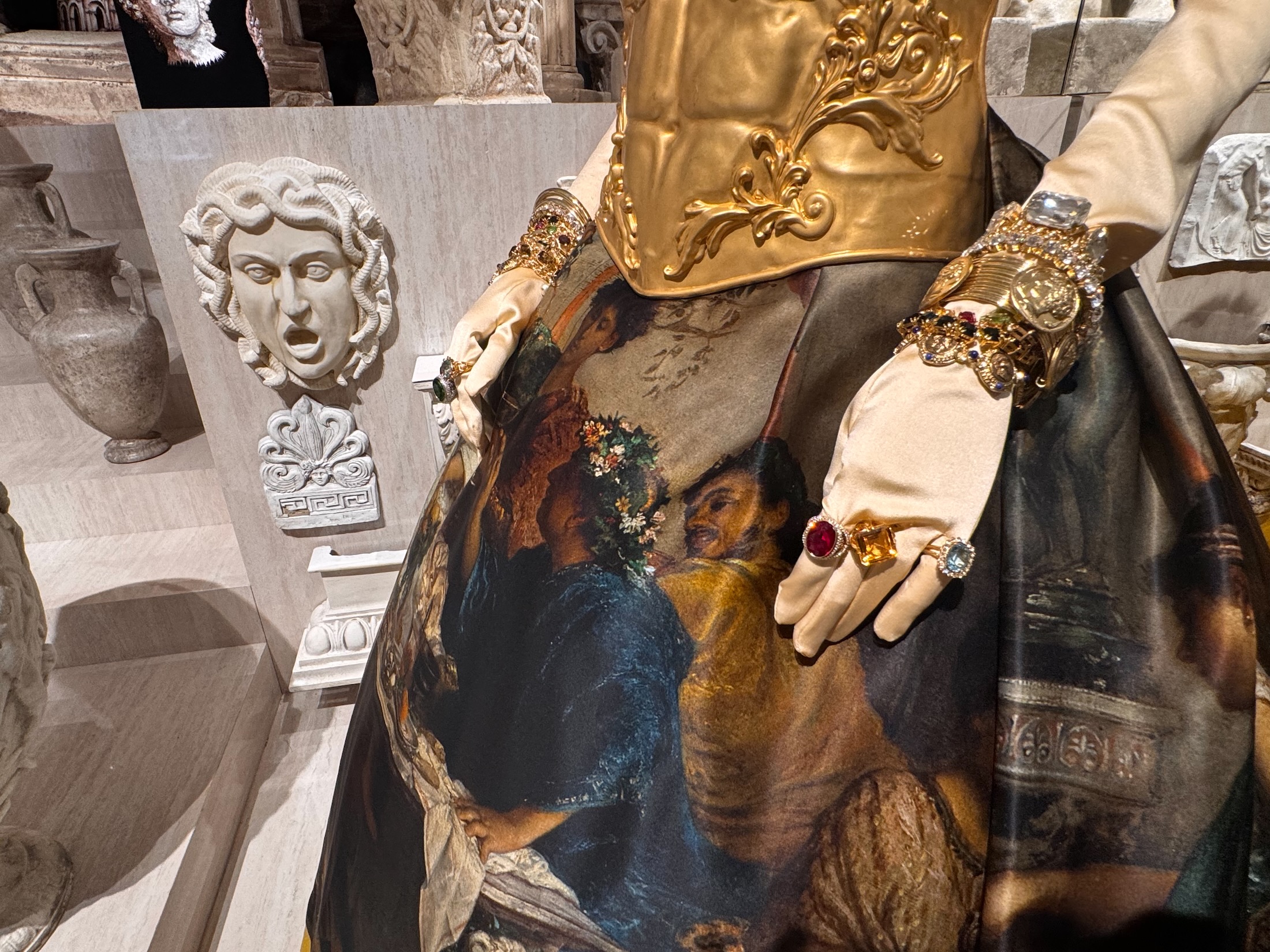
A Renaissance painting worn as a skirt, Alta Gioielleria rings on white gloves, a Medusa watching from the wall. Rome not as reference — as body.
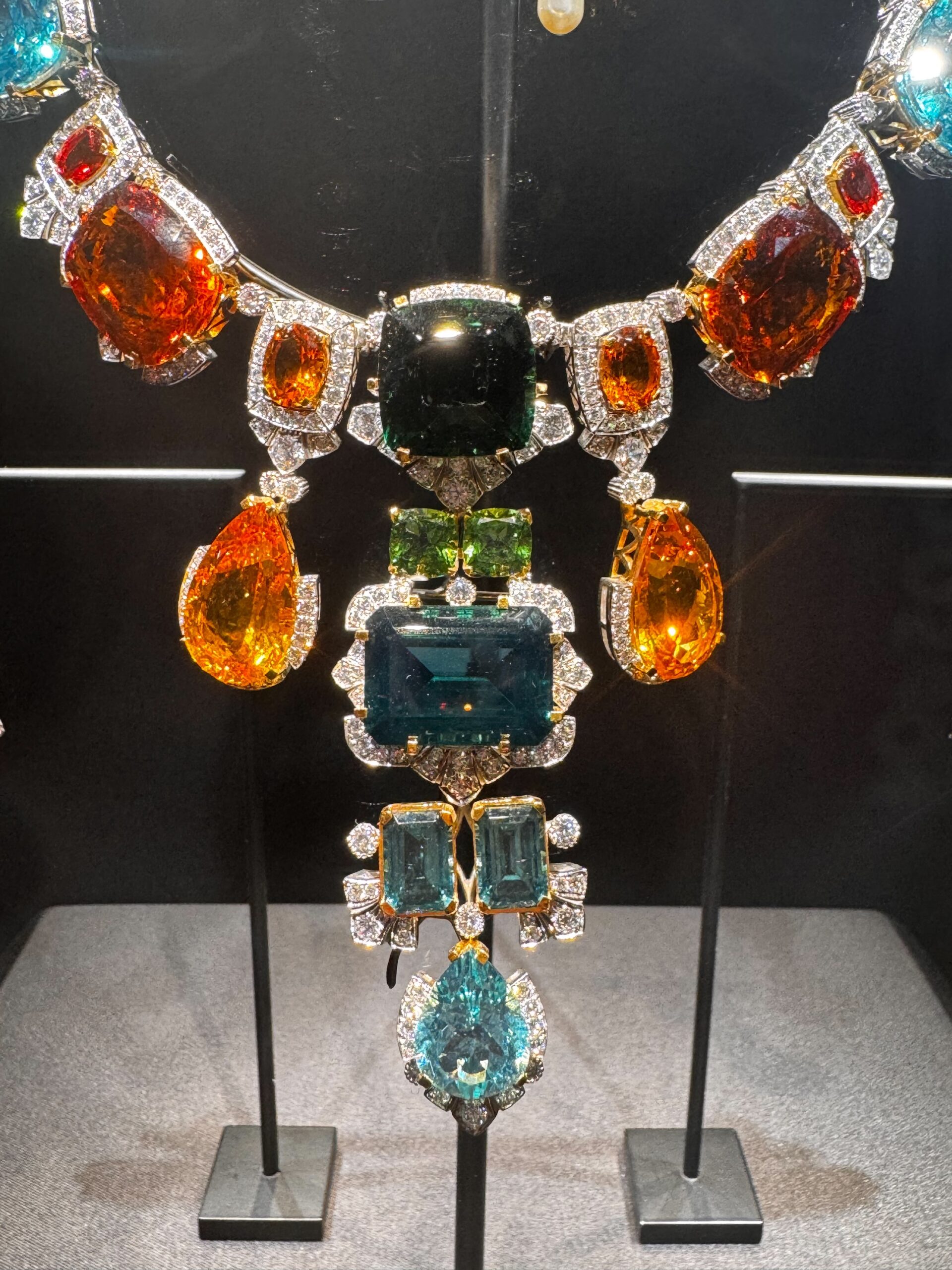
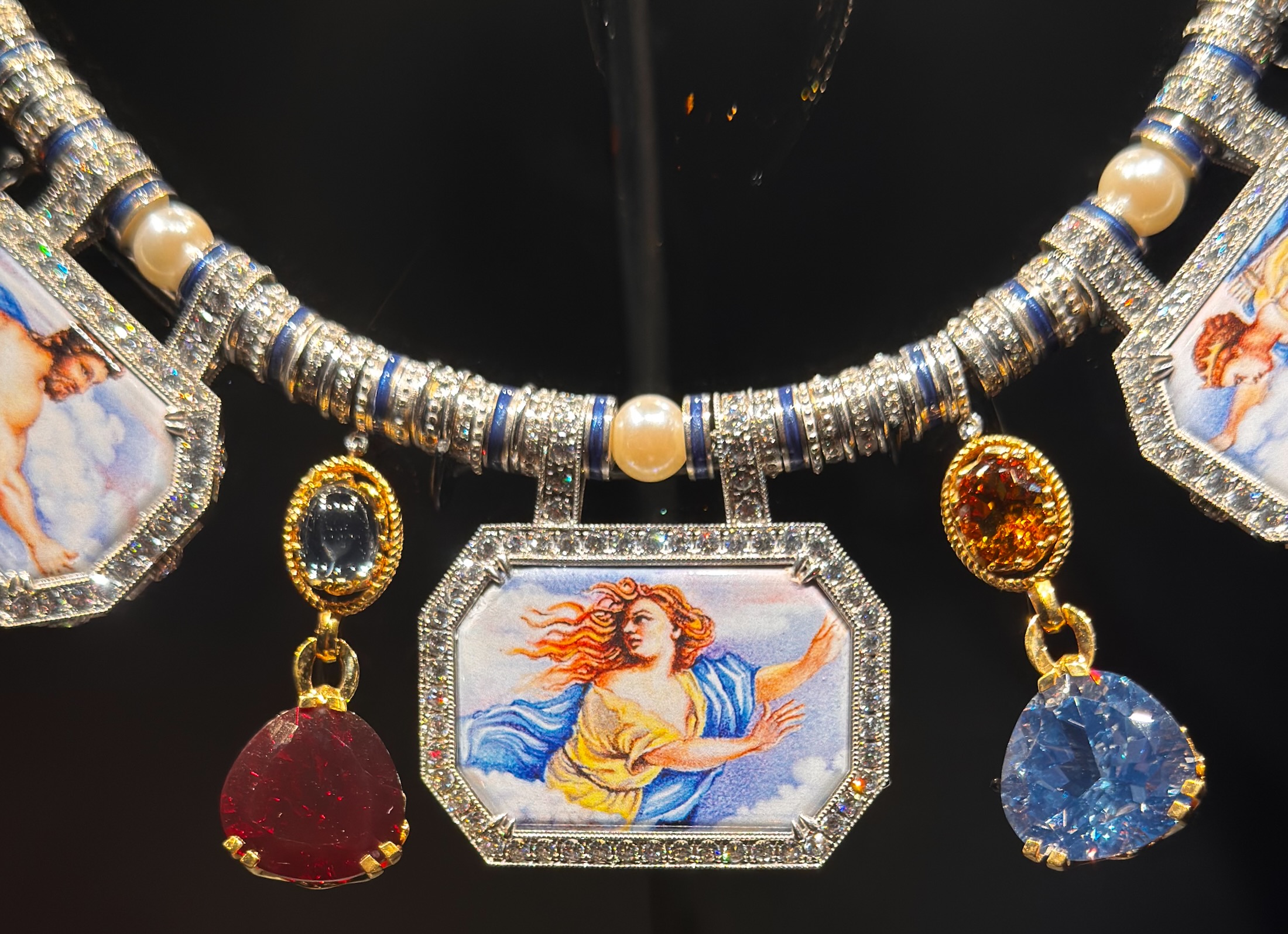
The Rome rooms, new to this Miami iteration, push further still. A gown printed with a Renaissance fresco. A molded gold baroque helmet at the collar. White gloves stacked with Alta Gioielleria cuffs and rings in ruby, citrine, aquamarine. A Medusa stone bust behind. Imperial symbolism, ecclesiastical pageantry, the eternal city not as reference — as source.
——
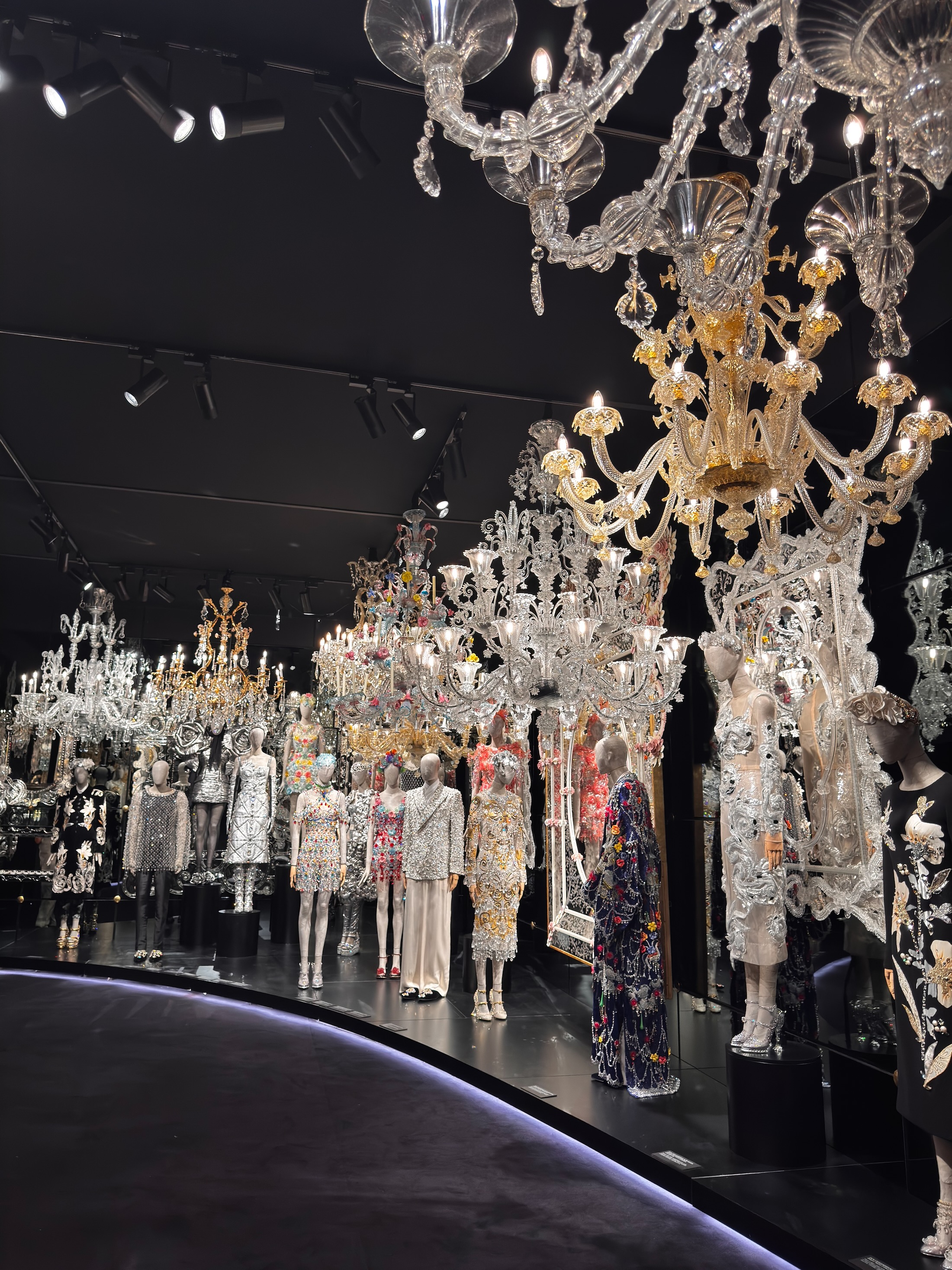
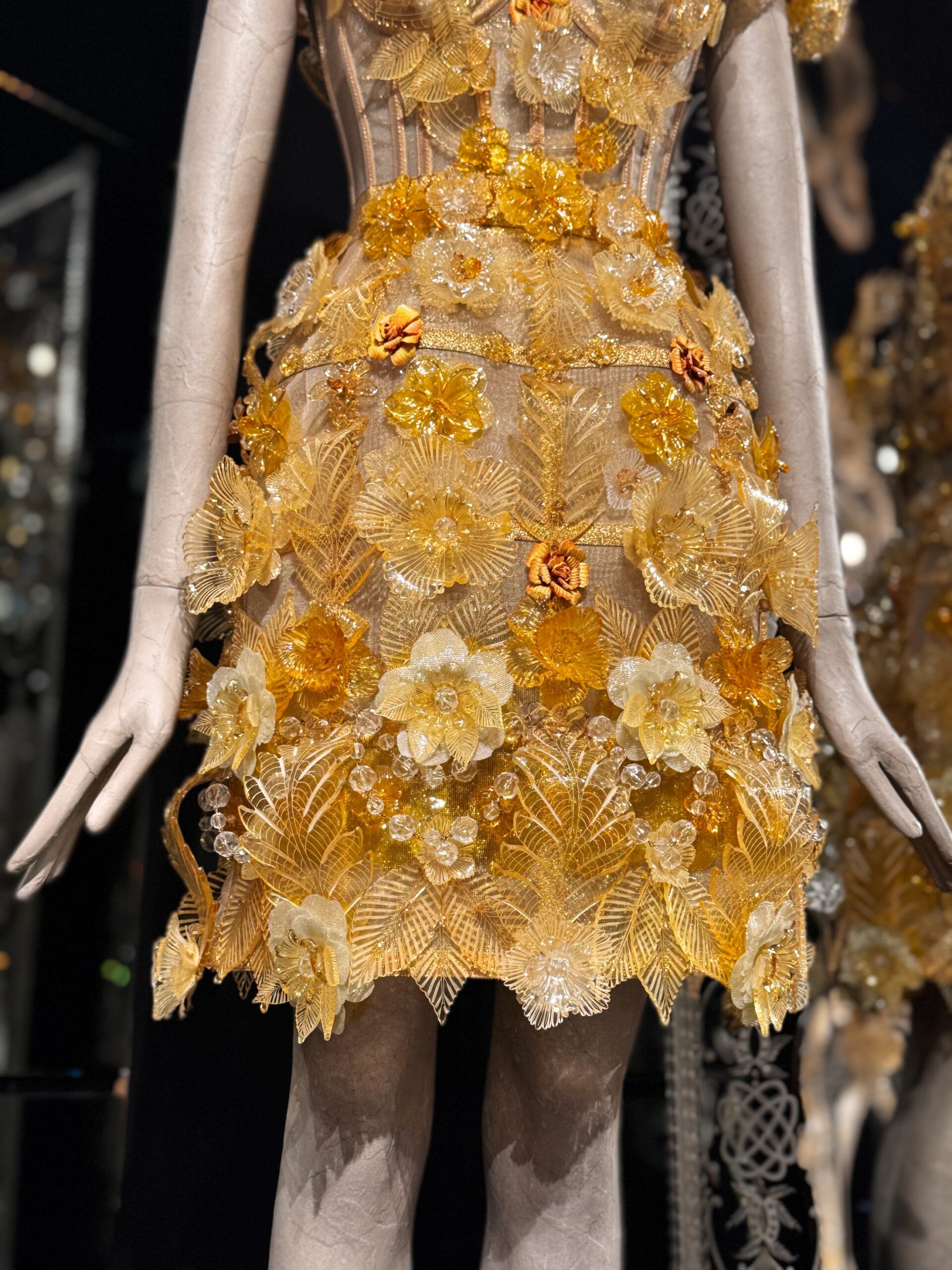
The Divine Mosaics room is technically vertiginous — Murano chandeliers crowding the ceiling, garments encrusted in crystal and colored glass refracting light in every direction. The sparkling wall behind the garments was created by Orsoni Venezia 1888, the furnace currently restoring St. Mark’s Basilica and the only one capable of reproducing the Gold of San Marco. This is not homage to Byzantine craft. It is its continuation. Nearby, a mini dress covered in individually sculpted glass flowers — pink, yellow, blue-green, each petal standing away from the fabric — stopped me so completely that someone walked into my back. I didn’t apologize. They understood.
——
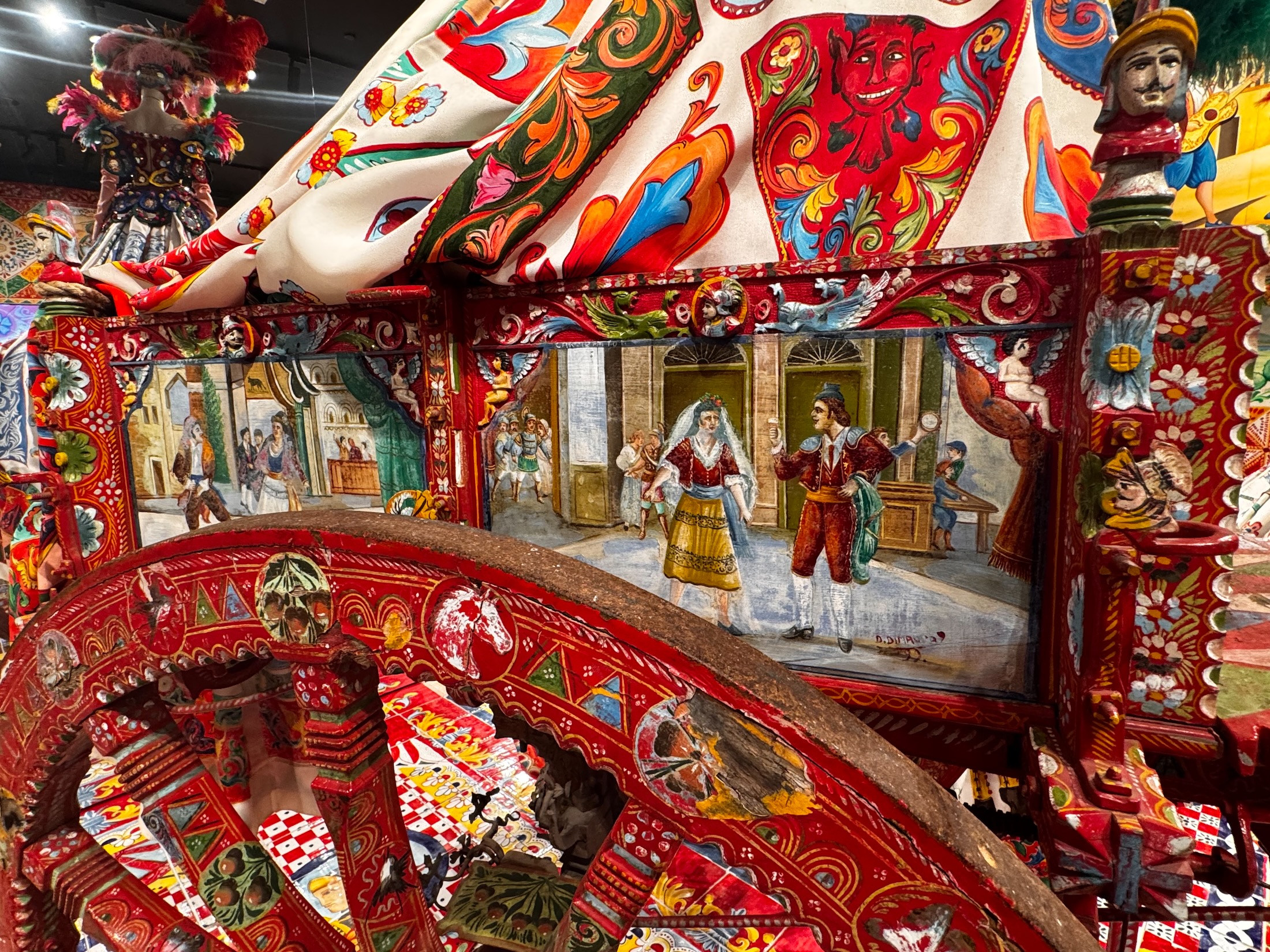
Sicilian cart detail — hand-painted wood, every figure placed by a craftsperson who learned the tradition from someone who learned it before them.
I have been to Sicily. I was there years ago, on a trip I still think about more than almost any other — the way the light in Taormina sits differently than anywhere else I’ve been, the markets in Palermo, the feeling of being somewhere that beauty and chaos have long since made peace with each other. That trip lives in me somewhere specific. Walking into the Sicilian Traditions room felt, for a moment, like going back.
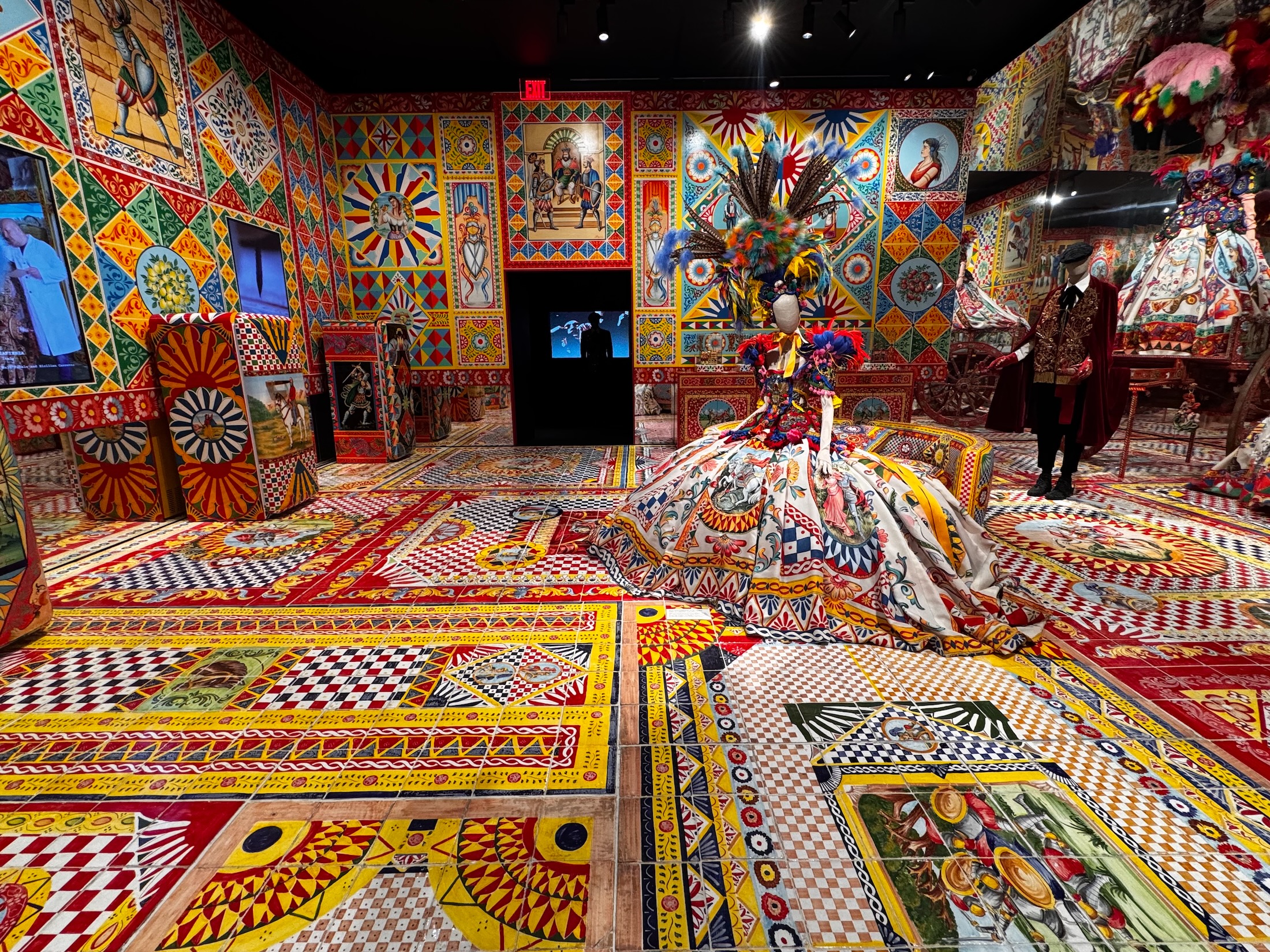
Every surface was made by Sicilian craftspeople — the painted walls, the tiled floors, the wooden transport cart used at the 2017 Palermo presentation. The central gown carries heraldic figures and folk scenes in embroidery so dense it reads as tapestry. A feathered headdress in blue, red, and green rises above it like something from a procession. A guard in the room — one of the hosts, really, stationed there all day — caught me smiling and said, almost to himself: “You can’t help it in here.” He was right. You really cannot.
Curator Müller designed the sequence deliberately — pulling you from the hushed dark of the sacred rooms into this wall of color and Tarantella with no transition. Because that is how Sicily actually works. How Italy works. Joy and grief at the same table, no ceremony, no explanation.
——
11. A detail from the Architectural and Pictorial section — a Caravaggio-scale still life rendered entirely in thread and bead. The cape is not printed. It is painted, slowly, by hand.
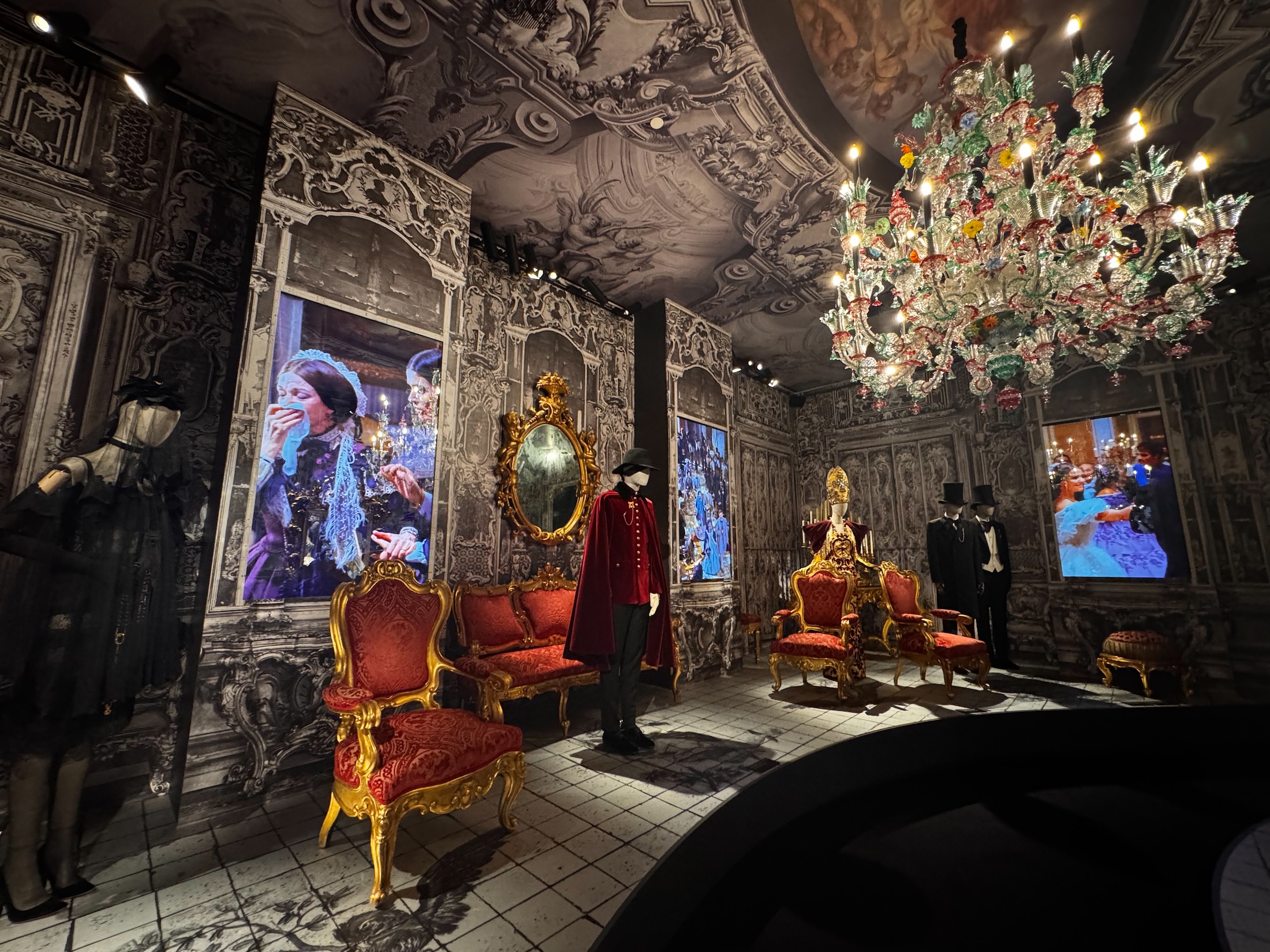
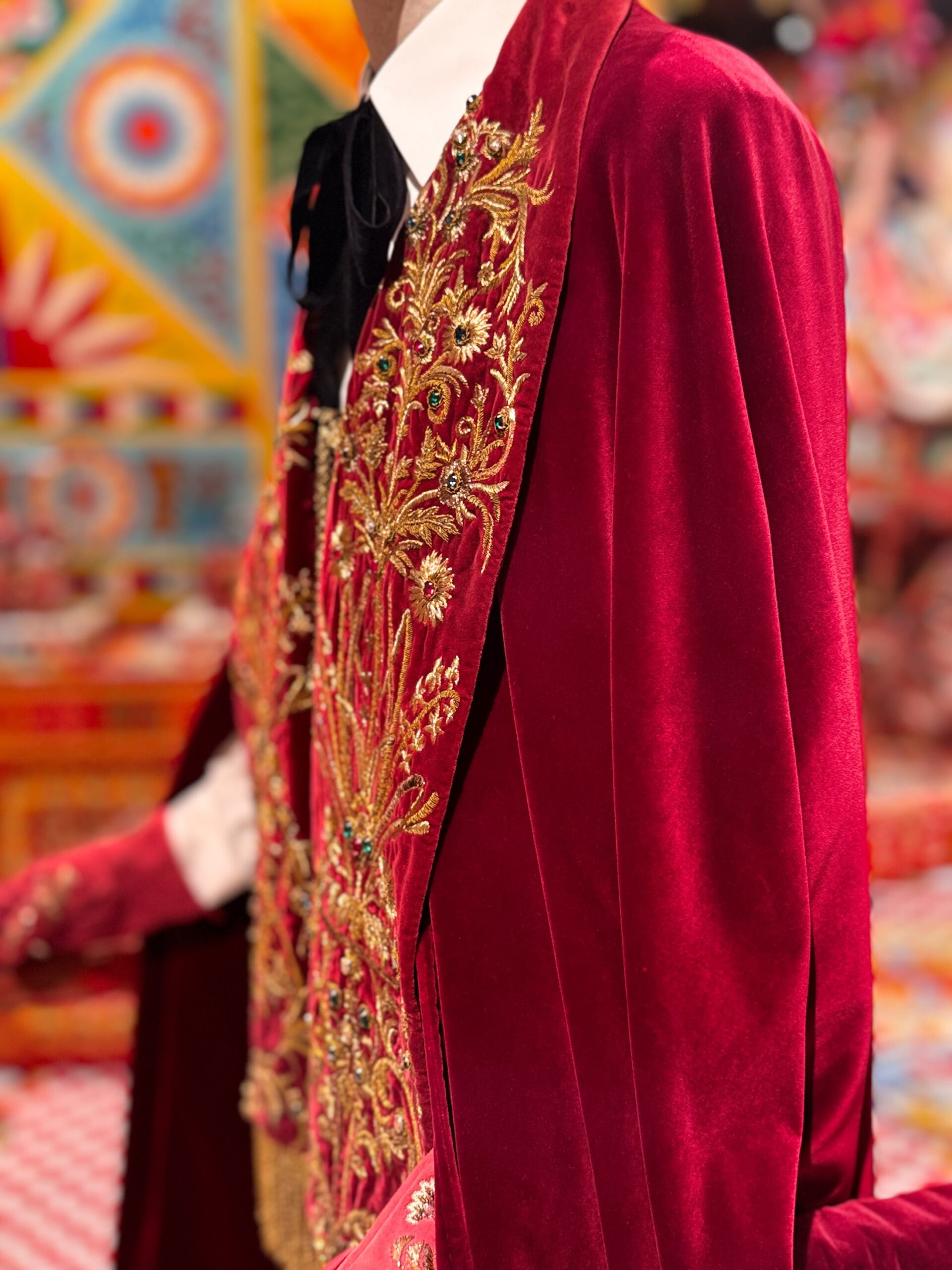
The Leopard room is where the exhibition gets honest about something most fashion exhibitions never touch. Baroque stucco walls in black and white, floor to ceiling. Gilded Venetian chairs in crimson velvet. A single deep red cape on one mannequin. Visconti’s 1963 masterpiece plays silently in one-way mirrors — Alain Delon as Tancredi, Burt Lancaster as the Prince of Salina, Claudia Cardinale as Angelica. The wall text is blunt: The Leopard is Domenico Dolce and Stefano Gabbana’s cult film. Sicily during the Risorgimento. Old aristocracy dissolving. A new order arriving. The Prince didn’t resist change out of stubbornness. He grieved it because he understood the cost. That tension — loving something while it leaves you — runs through everything they have ever made. I felt it standing there, watching a silent ballroom scene in a mirror, more clearly than I expected to.
——
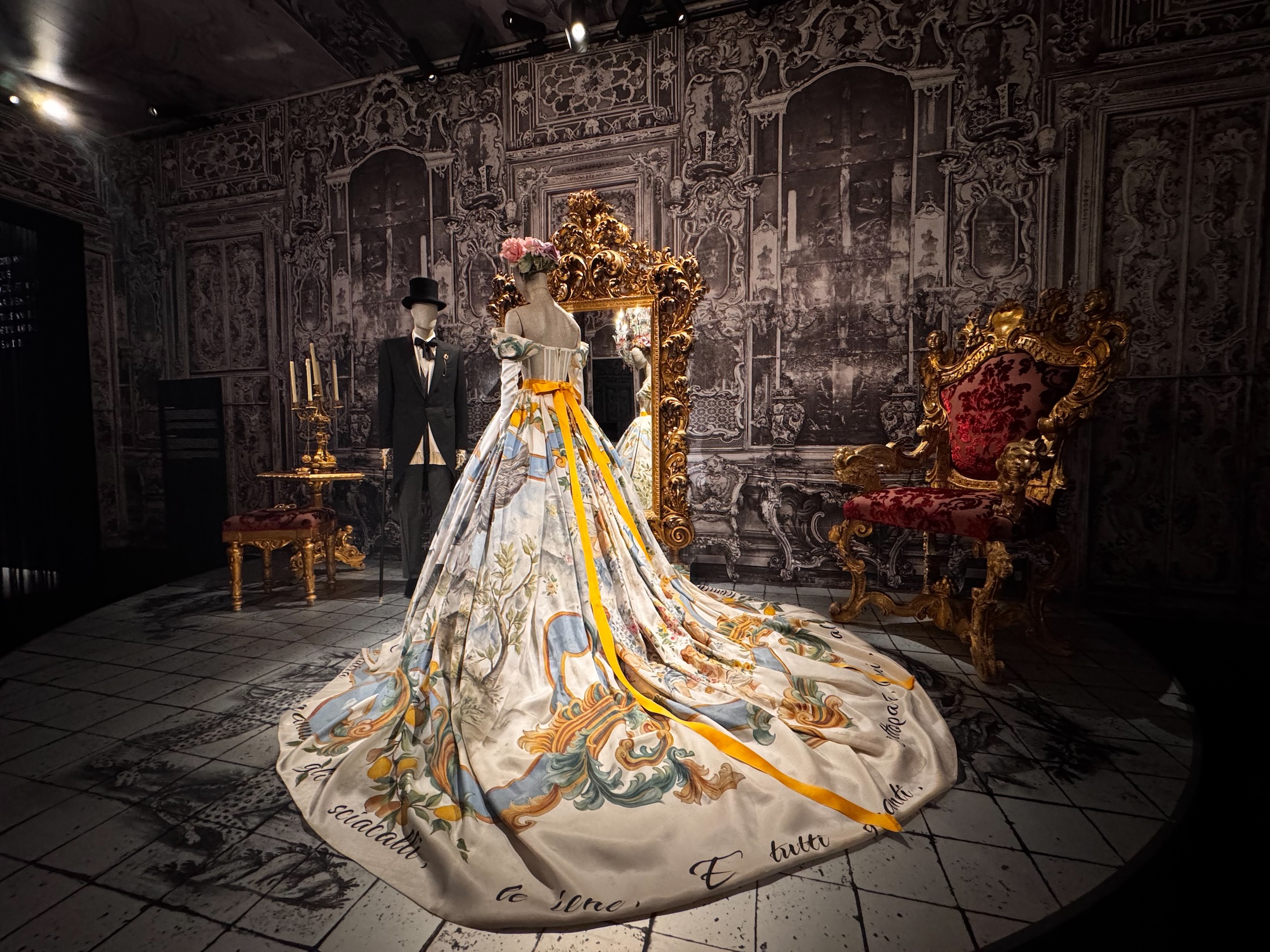
The gown Angelica never got to keep. Dolce&Gabbana’s Alta Moda answer to Visconti’s last waltz — the ballroom at Palazzo Gangi, an aristocracy that knew it was disappearing.
Near the close, the spectacle stops entirely. The Atelier room is a recreation of an actual Dolce&Gabbana workshop. Half-finished jackets. Unlined corsets. Design sketches pinned directly beside finished photographs. Cabinets of buttons sorted by material and size. Bolts of old fabric rescued from defunct Italian fashion houses. Tailor’s dummies padded in exactly the places a longtime client carries weight — a detail so specific and so tender that it stayed with me long after I left.
Everything that came before this room was made here first. By people whose names appear on no label. I thought about that on the drive home. Still thinking about it now.
——
The exhibition ends with opera. A black sequined Turandot cape, a gold-and-red dragon embroidered across its full length to the floor, the word TURANDOT lettered in gold at the shoulder. Tosca pieces beside it. Feathered headdresses, red velvet, Murano chandeliers, a banquet table with candelabra. Puccini. Verdi. Aida. Madama Butterfly. The operas all end in tragedy. Dolce&Gabbana’s response is not mourning. The garments refuse grief. They insist on beauty as defiance — not the denial of what is lost, but the refusal to let loss have the final word.
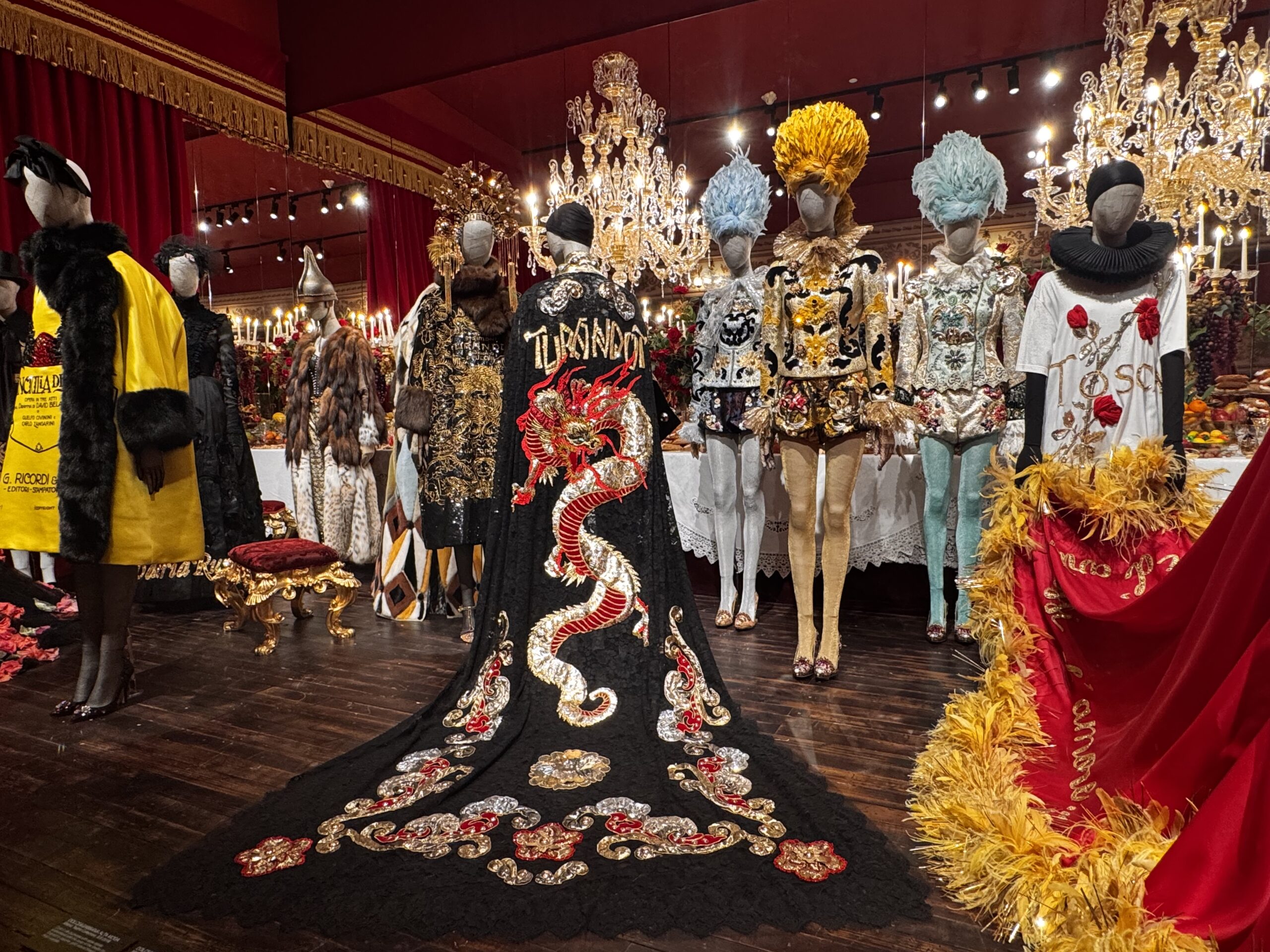
The Opera room. Puccini’s Turandot in black sequin and embroidered dragon. The exhibition ends here — not in mourning, but in defiance.
There was a text I photographed in the Sacro section, written by Monsignor Alberto Rocca of Milan’s Pinacoteca Ambrosiana. The room was dark and red and the words were barely holding still on the wall. I read it three times.
“This search for hidden beauty is a devotion not afraid to let go of what might be considered excessive, because devotion is love, and true love is always excessive. In every creation the whole is in the detail and the detail embellishes the whole. Approaching the sublime leads to the sacred mirror that shows each one his or her own heart.
Beauty without virtue is a curse.”
I stood in that exhibition for three hours. I left knowing exactly what mine looked like.
——
From the Heart to the Hands: Dolce&Gabbana
ICA Miami | 23 NE 41st Street, Miami Design District
Through June 14, 2026 | dolcegabbanaexhibition.com
Planning a trip to Miami? Read our Miami Design District guide ?
Discover Sicily through our eyes ?